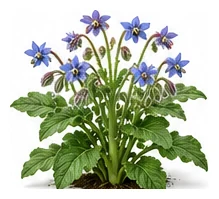
Whole plant
Overall shape, height, branching and growth habit.
Borago officinalis
Hardy annual with star-shaped blue flowers that are very attractive to bees. Flowers and young leaves are edible in small amounts only. Self-seeds freely.

When to sow, plant out and harvest in each climate. Plotera turns this into reminders for your own garden, location and planting dates.
| Climate | Sow | Transplant / Plant | Harvest |
|---|---|---|---|
| Tropical | Apr - Aug | Apr - Aug | Jan - Dec |
| Subtropical | Aug - Nov | Aug - Nov | Oct - Feb |
| Mediterranean | Sep - Nov | Sep - Nov | Nov - Feb |
| Temperate | Sep - Nov | Sep - Nov | Nov - Feb |
| Cool | Sep - Nov | Sep - Nov | Nov - Feb |
| Arid | Sep - Nov | Sep - Nov | Nov - Feb |
Borage is an annual herb with coarse, hairy leaves, branching stems and nodding, star-shaped blue flowers. Grow it for its informal appearance, its appeal to bees and its small edible flowers. It fits comfortably into herb gardens, flower borders and wildlife planting, although its loose growth needs room. Plants grow quickly from seed and often leave plentiful seedlings behind. This can provide future plants, but deadheading is worthwhile where you want to control its spread. Borage prefers a sunny position and tolerates relatively poor soil once established. Its brittle stems can suffer in wind, so choose a sheltered place or provide support. Flowers are best picked as they open. Treat edible use as an occasional garnish: borage contains pyrrolizidine alkaloids, so eat it only in small amounts and avoid it during pregnancy. Borage is listed as toxic to dogs, cats and horses.
Use reasonably well-drained ground, including sandy or loamy soil. Borage tolerates poor fertility and acid, neutral or alkaline conditions; heavy additions of compost are unnecessary. A raised bed or draining container is useful where ground stays wet.
Flowers contain male and female organs and attract bees. Pollination is unnecessary for harvesting flowers or leaves, but insect visits help produce seed. Hand-pollination is unnecessary for ordinary garden growing; allow selected flowers to mature if saving seed.
Stake plants in windy positions with loose ties. Cutting tired plants back by about half during summer can encourage fresh growth; deadhead instead of leaving seedheads when volunteers are unwanted.
Propagate by seed, preferably sown where plants will grow. Retain a few seedheads for seed collection or allow controlled self-seeding.
Borage is better sown in the ground: it dislikes root disturbance and plants can reach about 60–100 cm. If you want it in a pot, sow directly into a container at least 30 cm deep with drainage holes, thin to one plant per pot, choose a compact form such as the white-flowered types, and shelter or stake it against wind.
Look for ordinary blue-flowered forms for informal pollinator planting, or compact, sturdier white-flowered forms for pots.
White powdery patches develop on leaves. Improve spacing, prevent prolonged drought stress and remove badly affected growth.
Young leaves acquire irregular holes or seedlings disappear. Inspect after dark, remove offenders and grow seedlings strongly before exposing them to heavy feeding.
Brittle stems split or collapse. Choose shelter and stake plants before they become large.
Choose the coolest available growing period and ensure rapid drainage during heavy rain.
Use the milder season for establishment, with light shade where strong heat stresses plants.
Provide moisture during establishment and prolonged dry spells; mature plants tolerate relatively dry ground.
Direct sow after the last frost and use successive sowings to extend fresh growth.
Choose a sunny, sheltered position and sow when the ground is workable and warming.
Protect brittle stems from drying winds and water young plants until well rooted.
Overall shape, height, branching and growth habit.
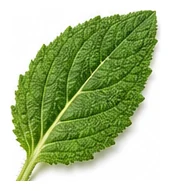
Leaf shape, edges, colour and vein pattern.
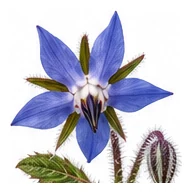
Flower colour, structure and where blooms appear.
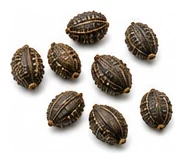
Fruit, root, seed, pod or the strongest identifying feature.
A quick garden-to-table guide for using Borage after harvest.
Use a few clean flowers as an occasional garnish for salads, desserts or drinks. Borage contains pyrrolizidine alkaloids, which can harm the liver, so eat it only in small amounts and avoid it during pregnancy, while breastfeeding or with liver disease.
Young, tender leaves have a cucumber-like flavour and are traditionally added in small amounts to soups and stews. Do not eat borage often or in quantity because of its pyrrolizidine alkaloids, and avoid it during pregnancy or breastfeeding.
Freeze occasional flowers in ice cubes for decorative use. Leaves are usually used fresh because drying reduces their flavour.
Try: Salad garnish, Drink garnish, Floral ice cubes.
No avoid list yet.
Self-seeds prolifically — deadhead or it will take over. Flowers can be frozen in ice cubes.
Create a free account to save your garden layout, personal planting calendar, water and fertiliser schedules, seed inventory and harvest logs.
Create Free Account