
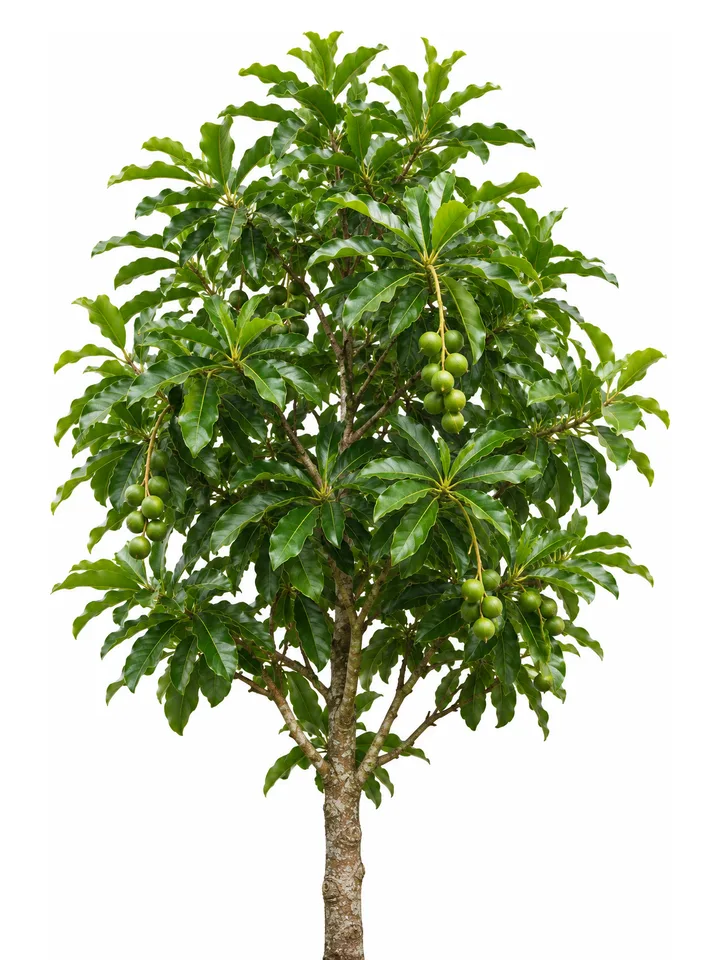
Whole plant
Overall shape, height, branching and growth habit.
Macadamia integrifolia
Dense evergreen tree, native to subtropical rainforest, with glossy wavy leaves, long sprays of cream flowers and round green husks holding a hard-shelled nut.
Contains persin, which is dangerous to birds, horses and some other animals.
When to sow, plant out and harvest in each climate. Plotera turns this into reminders for your own garden, location and planting dates.
| Climate | Sow | Transplant / Plant | Harvest |
|---|---|---|---|
| Tropical | From transplant | Jan - Dec | Mar - Aug |
| Subtropical | From transplant | Sep - Nov | Mar - Aug |
| Mediterranean | From transplant | Sep - Nov | Apr - Aug |
| Temperate | From transplant | Sep - Nov | Apr - Aug |
| Cool | Not suitable | Not suitable | Not suitable |
| Arid | Not suitable | Not suitable | Not suitable |
Macadamia is a large, dense evergreen nut tree native to subtropical rainforest in Australia. Long sprays of cream or pale-pink flowers are followed by green husks containing exceptionally hard shells and rich, crisp kernels. A grafted tree may produce a small crop after about five years, but full production can take twelve to fifteen years, so site selection is a long-term commitment. Trees need deep, well-drained acidic soil, dependable moisture and shelter from strong wind; shallow or waterlogged ground causes poor anchorage and root decline. Individual flowers are perfect, but many selections are largely self-incompatible, making two compatible cultivars and abundant insect activity important for strong nut set. Mature nuts fall naturally and should be gathered from the ground rather than picked prematurely. Remove the husks promptly and begin drying the shells in shade with free air circulation. Standard trees are too large for ordinary containers and can form broad, dark canopies. Choose grafted cultivars for known kernel quality, bearing habit, pest tolerance and a more predictable time to harvest.
Plant in at least 0.5 m, preferably about 1 m, of deep, well-drained soil rich in organic matter. Aim for pH 5.5–6.5 and use soil testing before correction. Avoid shallow rock, compacted clay and wet depressions; use a wide mound if drainage is marginal.
The long racemes carry many perfect flowers, but most cultivars are substantially self-incompatible. Bees, hoverflies and other insects transfer pollen. Plant two compatible grafted cultivars with overlapping bloom for dependable set. Hand-pollination is impractical on a mature tree.
Provide wind shelter and use flexible staking or other physical support during establishment where wind damage is likely. Train the young tree according to its cultivar's natural upright, spreading or rounded habit; remove conflicting inward-growing limbs and narrow, weak unions without forcing every tree into the same number of scaffold branches. Once bearing, prune gradually to remove dead, crowded or low growth and maintain access and light, avoiding removal of more than about one-fifth of the canopy in one session.
Selected cultivars are grafted onto seedling rootstocks because seedlings do not come true and take longer to prove their kernel quality. Fresh seed can produce rootstocks; remove the husk, sow about 2.5 cm deep and keep moist but not saturated. Cuttings are difficult and not the normal home method.
Macadamia is not suited to permanent container culture. Its eventual canopy, root system, wind exposure and long wait for a crop require open ground; a young grafted plant may be held briefly in a deep nursery container before planting.
Plant at least two compatible grafted cultivars. Choose narrow, upright forms for windy sites, compact forms where space is limited, and selections rated for high kernel recovery, regular bearing, strong branch structure and resistance to husk spot or anthracnose.
Feeding punctures developing nuts, causing premature drop and brown or corky kernel damage. Monitor from early nut development, remove unmanaged host growth nearby and conserve predators before considering further control.
Larvae enter husks or shells, leaving holes, frass, damaged kernels and early nut fall. Collect fallen nuts promptly, remove infested material and maintain orchard-floor sanitation.
Flower racemes brown and die during prolonged wet bloom weather. Improve air movement, remove blighted racemes and avoid overhead watering of flowers.
Dark spots develop on husks and nuts drop prematurely near maturity. Collect fallen nuts often, remove diseased husks and improve canopy airflow and sanitation.
Dark sunken bark, gumming, thinning foliage or slow decline occurs where trunks are injured or water ponds. Improve drainage, keep mulch away from bark, protect the trunk and prune only with clean tools.
Choose a site with some seasonal cooling, good air movement and excellent drainage. Persistently wet bloom weather increases flower and husk diseases.
This is the preferred climate, provided strong wind and waterlogging are avoided. Reliable moisture supports flowering and nut filling.
Trees can grow with irrigation, but protect them from dry wind and provide deep watering through the long nut-development period.
Use the warmest frost-sheltered site and a cultivar proven under cooler conditions. Young trees, flowers and new growth are more cold-sensitive than mature foliage.
The tree is generally unsuitable because frost damages young growth and the long warm season needed for kernel development is lacking.
Provide strong wind shelter, broad mulch and efficient irrigation across the root zone. Extreme heat above about 35 °C can suppress growth and damage exposed tissues.
Overall shape, height, branching and growth habit.
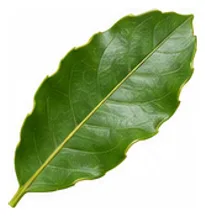
Leaf shape, edges, colour and vein pattern.

Flower colour, structure and where blooms appear.

Fruit, root, seed, pod or the strongest identifying feature.
A quick garden-to-table guide for using Macadamia after harvest.
Eat only mature, properly dried kernels after removing the husk and hard shell. Discard shrivelled, mouldy, insect-damaged or rancid-smelling kernels, and keep macadamia nuts and foods containing them away from dogs.
Dry-roast kernels gently and use them whole, chopped or ground in baking, confectionery and savoury dishes. Their high oil content means they brown readily.
Collect fallen nuts promptly, dehusk within 24 hours and air-dry them in shell in shade with good ventilation. Store dried kernels airtight in the refrigerator or freezer to slow rancidity.
Try: Roasted nuts, Macadamia cookies, Nut butter, Crumbed fish.
No avoid list yet.
Collect nuts as they fall, dry them in the shell for a few weeks, then crack.
Create a free account to save your garden layout, personal planting calendar, water and fertiliser schedules, seed inventory and harvest logs.
Create Free Account