
Whole plant
Overall shape, height, branching and growth habit.
Petunia × atkinsiana
A colourful warm-season flowering plant widely grown in beds, containers and hanging baskets. Petunias flower heavily in good light and benefit from regular feeding and occasional trimming.
When to sow, plant out and harvest in each climate. Plotera turns this into reminders for your own garden, location and planting dates.
| Climate | Sow | Transplant / Plant | Harvest |
|---|
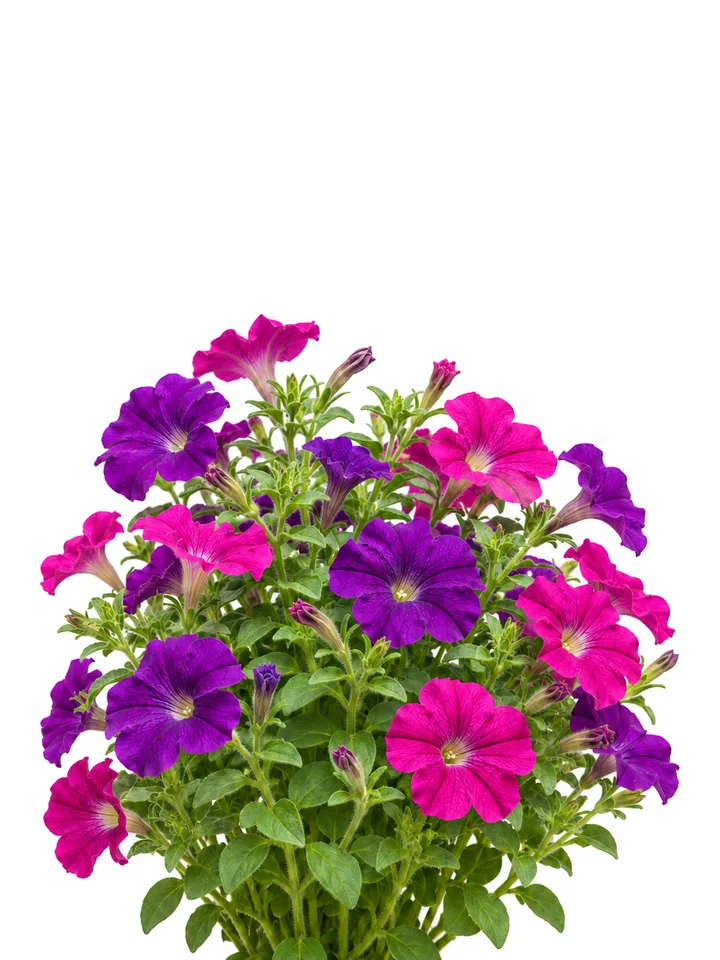
Petunias are tender flowering plants usually grown as annuals for a long display in sunny beds, pots and hanging baskets. Their trumpet-shaped flowers come in many colours, patterns and sizes, and plants range from compact mounds to vigorous trailers. Large-flowered forms give an impressive display in sheltered positions, while smaller-flowered types generally recover better from rain. Expect flowering through the warm growing season until cold ends the display, provided plants receive enough light, water and nutrition. Shade produces stretched growth and fewer blooms. Many modern small-flowered varieties shed faded flowers themselves, while large or double flowers often benefit from deadheading. Plants that become straggly can usually be shortened to encourage fresh branching. Raising petunias from their dust-like seed requires care and an early start; transplants are simpler. Grow petunias as ornamentals rather than food plants. They are listed as non-toxic to cats, dogs and horses.
Use light, moderately fertile, well-drained soil improved with compost. For garden beds, pH 6.0–7.0 is suitable; soilless container mixes generally need a lower pH, around 5.4–6.2. Use raised beds where ground stays wet.
Flowers have male and female organs. Many garden hybrid lines are self-compatible; bees and moths can transfer pollen. Fertility varies among hybrids, so do not expect every cultivar to set useful seed. Pollination is unnecessary for flowers, and saved hybrid seed may not resemble its parent.
No trellis is needed. Pinch young grandiflora and multiflora plants for branching, but compact milliflora and spreading types often need no initial pinching. Cut lanky growth back by about half.
Grow from seed or root healthy stem cuttings to retain a favourite cultivar. Hybrid seedlings are variable.
Choose a draining pot with at least about 20 cm of potting-mix depth; vigorous trailers need substantially more root space than compact plants.
Choose multiflora types for weather tolerance, milliflora types for compact pots, spreading types for baskets or groundcover, and grandiflora types for large flowers in sheltered positions.
Shoot tips become crowded with insects and sticky honeydew. Remove small colonies by hand and encourage predators.
Flowers turn brown and develop fuzzy grey mould in damp weather. Remove affected blooms, improve airflow and water the soil.
Plants wilt despite wet soil and stems or roots decay. Remove affected plants and correct drainage before replanting.
Leaves and flowers have irregular holes. Inspect after dark and remove animals feeding on plants.
Use a sunny, freely drained position during less persistently wet conditions. Smaller flowers usually withstand rain better than large doubles.
Plant during mild to warm frost-free conditions; humidity and heavy rain can shorten flower life.
Plant after frost danger and provide deep watering through dry summers, especially in baskets.
Start seed under cover well before planting out after the last frost.
Use an early indoor start and a warm, sunny site; cold soil delays establishment.
Shelter baskets from desiccating wind and check moisture daily while maintaining free drainage.
Overall shape, height, branching and growth habit.

Leaf shape, edges, colour and vein pattern.

Flower colour, structure and where blooms appear.

Fruit, root, seed, pod or the strongest identifying feature.
No companion data yet.
No avoid list yet.
Petunia seed is tiny and should be surface-sown or barely covered. Trim straggly plants to encourage branching and another flush of flowers.
Create a free account to save your garden layout, personal planting calendar, water and fertiliser schedules, seed inventory and harvest logs.
Create Free Account