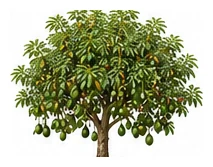
Whole plant
Overall shape, height, branching and growth habit.
Persea americana
Evergreen subtropical fruit tree. Needs drainage, shelter and compatible flowering types for best fruit set.
Contains persin, which is dangerous to birds, horses and some other animals.
When to sow, plant out and harvest in each climate. Plotera turns this into reminders for your own garden, location and planting dates.
| Climate | Sow | Transplant / Plant | Harvest |
|---|---|---|---|
| Tropical | From transplant | Jan - Dec | Jan - Dec |
| Subtropical | From transplant | Mar - Sep | Jan - Dec |
| Mediterranean | From transplant | Mar - May | Jun - Nov |
| Temperate | From transplant | Mar - May | Jun - Oct |
| Cool | From transplant | Mar - May | Jul - Oct |
| Arid | From transplant | Mar - May | Jun - Nov |
Avocado is an evergreen fruit tree with a broad canopy and shallow, sensitive feeder roots. A grafted tree of a suitable variety is the most practical starting point for home fruit production. Seed-grown plants are interesting to raise but may take much longer to crop and will not reliably reproduce the original fruit. Climate suitability varies considerably between varieties, so choose for local winter temperatures, summer conditions and disease pressure. Excellent drainage is essential: a tree can wilt in wet soil because damaged roots cannot supply water. Shelter from strong wind and protect young bark from intense sun. Flowering can be abundant while only a small proportion of flowers produce fruit, and some early fruit shedding is normal. Mature fruit generally softens after picking rather than on the tree, so test a sample before harvesting heavily.
Use well-aerated, freely draining soil, ideally around pH 6.0–6.5. Sandy loam is suitable, but drainage matters more than texture. Maintain organic mulch over the root zone without touching the trunk. Plant on a broad mound where necessary; avoid deep planting, compacted soil and rich amendments concentrated in the planting hole.
Each perfect flower opens first in a female phase and later in a male phase. A and B types usually follow complementary schedules, but temperature changes their timing. Some varieties crop alone; an opposite flowering type with overlapping bloom can improve unreliable set. Bees and other flying insects move pollen between trees. Hand-pollination is usually less practical than improving pollinator access and variety matching.
Support a young tree if needed without constricting the trunk. Begin light size control while the tree is young, generally after harvest and after frost danger; avoid heavy cuts that suddenly expose bark to strong sun.
Grafting onto suitable rootstocks preserves a named variety and improves cropping predictability. Seedlings are useful for experimentation or rootstocks; ordinary stem cuttings and air-layering are unreliable home methods.
Containers are better suited to compact grafted plants than full-sized varieties, but dependable fruiting is harder than in the ground. Use a large, freely draining container that accommodates the rootball, enlarge it as roots fill it and avoid oversized pots that remain wet.
Choose locally proven warm-climate or more cold-tolerant types, noting their A or B flowering class. Look for compact grafted forms where space is limited and suitable disease-tolerant rootstocks where available.
Small pale leaves, wilt and branch dieback occur despite wet soil; fine roots become dark and brittle. Improve drainage and irrigation, use healthy planting stock and avoid moving contaminated soil.
Dark, sunken spots enlarge as fruit ripens. Handle fruit gently, remove decaying material and reduce fruit injuries and persistent canopy dampness.
Exposed bark or fruit develops damaged, discoloured patches after intense sun. Protect young trees and retain enough canopy to shade larger branches.
Leaf tips and margins brown as salts accumulate. Check irrigation-water quality, ensure drainage and avoid excessive fertilizer or salty manure.
Choose varieties proven for warm, frost-free conditions. Excellent drainage is especially important during prolonged rain.
Many varieties suit sheltered sites, but young trees need protection from occasional frost and strong wind.
Match varieties to winter temperatures and maintain irrigation through dry summers. Protect young trees from hot sun.
Only mild, sheltered sites suit reliable outdoor fruiting; choose locally proven cold-tolerant types.
Ordinary outdoor conditions are generally unsuitable for dependable fruit. Protected plants may remain mainly ornamental.
Dry wind, intense sun and saline water can be limiting. Provide shelter, reliable irrigation and careful salt management.
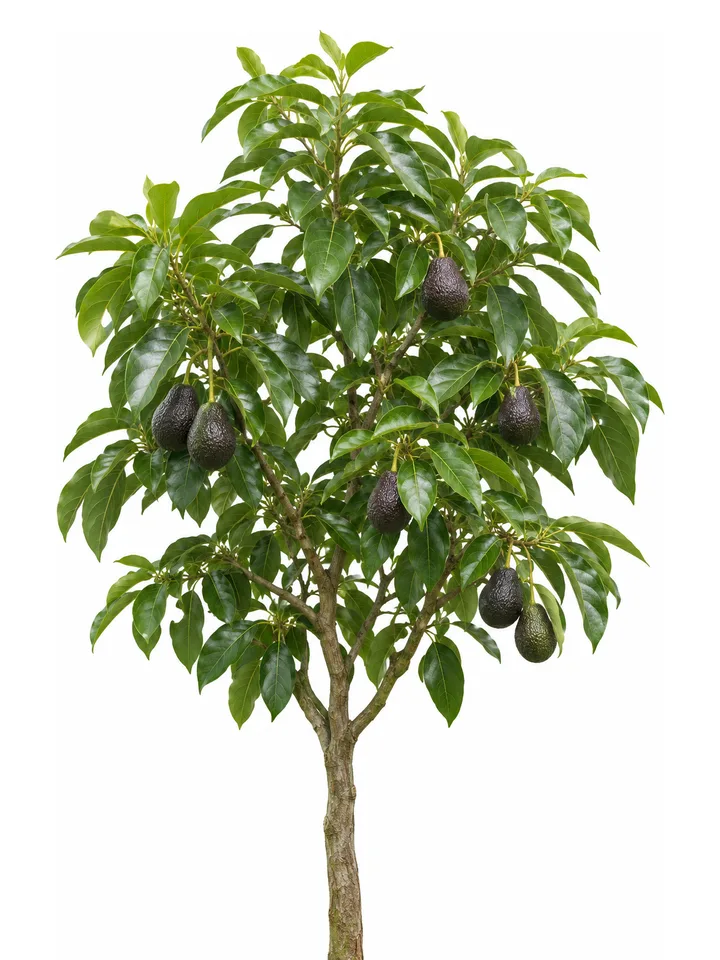
Overall shape, height, branching and growth habit.
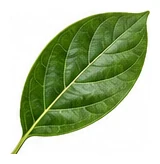
Leaf shape, edges, colour and vein pattern.
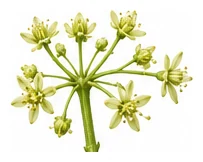
Flower colour, structure and where blooms appear.
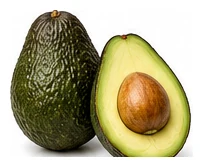
Fruit, root, seed, pod or the strongest identifying feature.
A quick garden-to-table guide for using Avocado after harvest.
Allow mature fruit to soften after picking, then use the flesh in salads, sandwiches or dips. Remove the skin and seed. Keep leaves, skins, pits and fruit away from pet birds, livestock and other animals: they contain persin, which is toxic to many animals, and a swallowed pit can block a dog's gut.
Use ripe flesh in warm savoury dishes, adding it near serving to retain its texture.
Freeze ripe flesh as purée in sealed freezer containers, leaving expansion space. Whole or sliced fruit freezes less satisfactorily.
Try: Guacamole, Salad slices, Sandwich filling, Frozen purée.
No avoid list yet.
Choose varieties suited to your climate and plant A/B flowering types if pollination is poor.
Create a free account to save your garden layout, personal planting calendar, water and fertiliser schedules, seed inventory and harvest logs.
Create Free Account