

Direct sow root crops
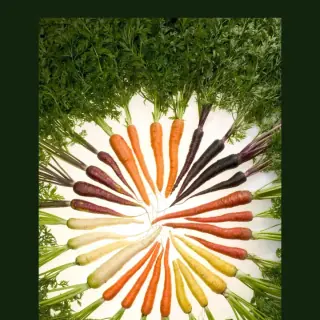
Carrots, radishes, parsnips and most root crops resent transplanting, because disturbing the taproot causes forking and stunting. Sow them where they will grow.
Seed sowing has a narrow margin for error and very clear rules. Almost every failure traces back to one of three things: sown too deep, allowed to dry out, or sown into soil that is too cold. None of them are visible until nothing comes up.
Depth first. A seed carries only enough stored energy to reach the surface once. Sown too deep it exhausts itself underground, and you never find out why. The general rule is to cover a seed to roughly two or three times its own thickness, which for many small seeds means barely covering them at all.
Moisture second, and it must be constant. A seed that begins germinating and then dries out is dead, not dormant. This is the reason seed trays fail more often than direct sowings — a small volume of mix dries in hours on a warm day.
Soil temperature third. Germination times assume a suitable temperature; below it, seeds sit and wait, and may rot before they sprout. The same seed can take twice as long in cold soil as the figures below suggest.
Larger seeds go deeper; fine seed is barely covered.
Sorted shallowest first, covering the vegetables, herbs and grains actually raised from seed. The shallow end is where most mistakes happen, because those seeds need barely any covering at all.
| Crop | Sowing depth | Germination | Category |
|---|---|---|---|
 Amaranth Amaranth | 0.3 cm | 5-10 days | Leafy Greens |
 Basil Basil | 0.3 cm | 5-10 days | Herbs |
 Celeriac Celeriac | 0.3 cm | 14-21 days | Roots |
 Celery Celery | 0.3 cm | 14-21 days | Other |
 Chia Chia | 0.3 cm | 7-14 days | Grasses & Grains |
 Chinese Celery Chinese Celery | 0.3 cm | 10-21 days | Herbs |
| Crop | Sowing depth | Germination | Category |
|---|---|---|---|
 Dill Dill | 0.3 cm | 7-14 days | Herbs |
 Lettuce Lettuce | 0.3 cm | 4-10 days | Leafy Greens |
 Marjoram Marjoram | 0.3 cm | 7-14 days | Herbs |
 Angelica Angelica | 0.5 cm | 14-28 days | Herbs |
 Bok Choy Bok Choy | 0.5 cm | 4-7 days | Brassicas |
 Cabbage, Wombok Cabbage, Wombok | 0.5 cm | 4-7 days | Brassicas |
 Capsicum Capsicum | 0.5 cm | 10-21 days | Solanums |
 Carrot Carrot | 0.5 cm | 14-21 days | Roots |
 Celtuce Celtuce | 0.5 cm | 4-10 days | Leafy Greens |
 Cherry Tomato Cherry Tomato | 0.5 cm | 6-14 days | Solanums |
Perennial fruit, citrus and berries are left out: they are grown from transplants, cuttings or grafts rather than sown, so they have no sowing depth. Germination times assume reasonable soil temperature and consistent moisture.
Carrots, radishes, parsnips and most root crops resent transplanting, because disturbing the taproot causes forking and stunting. Sow them where they will grow.
Crops with a long lead time benefit from a head start in trays, where you can control warmth and moisture precisely. They also protect expensive seed from pests at the most vulnerable stage.
The trade-off is vigilance. A tray holds very little mix and can dry in a single warm afternoon, which is fatal mid-germination. A ground bed is far more forgiving of a missed check.
Recording the sowing date is what lets you tell slow from failed. If the germination window has passed with nothing showing, re-sow rather than keep waiting.
Sowing in rounds also hedges against a failed batch — see the succession sowing guide.
Soil temperature is why sowing windows exist. The planting calendar shows what suits now.
A common rule is to cover a seed to two or three times its own thickness. For fine seeds such as lettuce and many herbs that means barely covering them; for large seeds such as beans and peas it means a few centimetres. Individual figures are on each plant guide.
The usual causes are sowing too deep, letting the seed dry out part-way through germination, or sowing into soil that is too cold. Old seed and sowing outside the crop's window are also common. Recording the sowing date makes it possible to tell a failure from a slow germinator.
Some large or hard-coated seeds benefit, but most vegetable seed does not need it and soaked seed is more awkward to handle. Consistent moisture in the soil after sowing matters far more.
Anywhere from a few days to several weeks depending on the crop and the temperature. Each plant guide records a germination range; treat the upper figure as the point at which to consider re-sowing.
Yes, though it is less often fatal than sowing too deep. Very shallow seed can wash away, dry out faster, or fail to anchor properly. Firming the soil so the seed makes contact with damp soil helps.
Sowing dates are recorded per zone alongside the expected germination window, so you can see at a glance whether something is late or simply has not had time yet.
Create a free account to save your garden layout, personal planting calendar, water and fertiliser schedules, seed inventory and harvest logs.
Create Free Account